
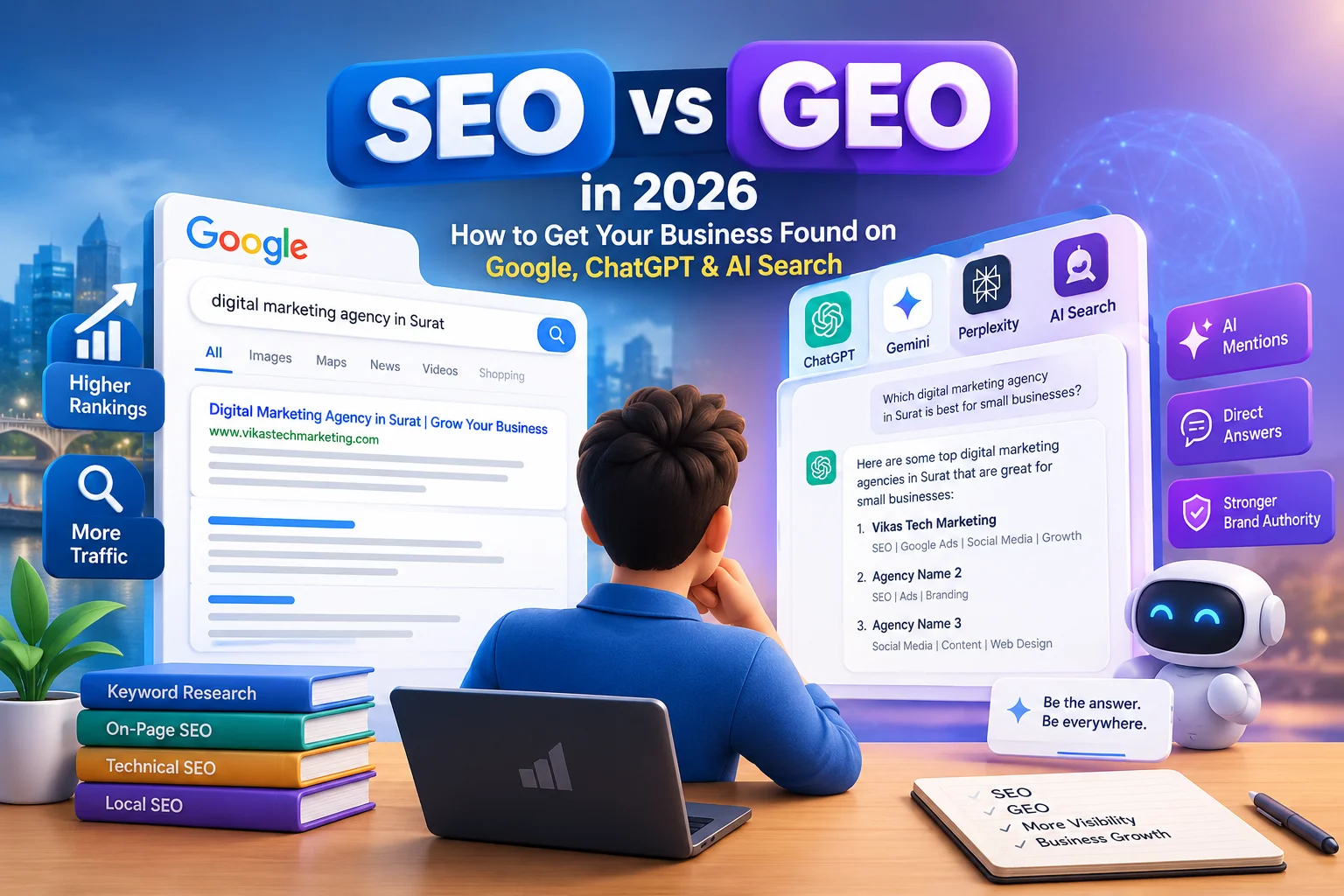
The way people search for information is changing.
Earlier, a customer would type a keyword into Google, open several websites, compare the results and make a decision.
Today, the journey can be very different.
A person may search Google and see an AI-generated overview, or ask an AI-powered search tool a detailed question and expect a direct answer.
For example, instead of searching:
“digital marketing agency in Surat”
a business owner might ask:
“Which digital marketing strategies can help a small business in Surat generate more leads?”
This change has created a new conversation in digital marketing: SEO vs GEO.
SEO, or Search Engine Optimization, focuses on making websites more useful and discoverable in search engines.
GEO, commonly used to mean Generative Engine Optimization, describes efforts aimed at making information easier for generative AI and AI-powered search experiences to understand, retrieve and potentially reference.
However, GEO should not be treated as a replacement for SEO.
Google’s current guidance makes this point clearly: its generative search experiences are built on its core Search systems, so foundational SEO remains important. Google also recommends unique, valuable, people-first content rather than attempting to manipulate AI search with artificial “GEO hacks.”
So the better question is not:
“Should I choose SEO or GEO?”
It is:
“How can I build a website that is useful for people, strong in traditional search and understandable in AI-powered search?”
Let’s explore the answer.
What Is SEO?
SEO stands for Search Engine Optimization.
It is the process of improving a website so search engines can understand its content and users can find useful information through organic search.
A strong SEO strategy normally includes:
- Keyword research
- Search intent analysis
- Helpful content
- On-page SEO
- Technical SEO
- Internal linking
- Local SEO
- Website performance
- Structured data where appropriate
- Author and business credibility
- Relevant external references and mentions
For example, if a business provides digital marketing services in Surat, its SEO strategy might target topics such as:
- Digital marketing agency in Surat
- SEO services in Surat
- Google Ads services in Surat
- Meta Ads services
- Local SEO for small businesses
- Digital marketing strategies for local businesses
But modern SEO is not simply about inserting keywords into an article.
Google’s current guidance emphasizes creating content that is useful, reliable, unique and satisfying for visitors.
What Is GEO?
GEO commonly stands for Generative Engine Optimization.
The term is used to describe strategies intended to improve the visibility and understanding of a brand or website in generative AI and AI-powered search experiences.
Examples of AI-powered search experiences include:
- Google AI Overviews
- Google AI Mode
- Other AI-powered search interfaces
- Conversational search experiences
The important thing to understand is that GEO is not a magic formula.
There is no guaranteed technique that makes ChatGPT, Google AI or another AI system recommend a particular business.
Google itself says that AEO and GEO are terms used to describe work focused on improving visibility in AI search experiences, but from Google’s perspective this is still part of the broader search optimization process.
That means businesses should focus on the fundamentals:
Create useful information → make it easy to understand → establish credibility → build a strong website → maintain technical SEO → provide original value.
SEO vs GEO: What’s the Difference?
The simplest way to understand the difference is this:
| SEO | GEO |
|---|---|
| Search Engine Optimization | Generative Engine Optimization |
| Primarily focuses on search visibility | Focuses on visibility in generative/AI search experiences |
| Search rankings and organic traffic are important | AI visibility, mentions and references may be relevant |
| Keywords and search intent matter | Questions, entities, context and clear answers become especially useful |
| Technical SEO is important | Technical SEO still matters |
| Internal linking is important | Clear content relationships can help AI systems understand information |
| Local SEO matters | Local business information can also be useful for AI-powered discovery |
| Traditional search remains central | AI-powered search is an additional discovery layer |
The key takeaway is:
GEO does not replace SEO.
Instead, businesses should think about AI search as an additional way users may discover information.
Does GEO Replace SEO in 2026?
No.
This is one of the biggest misconceptions surrounding GEO.
Google’s official guidance says that SEO best practices remain relevant because its generative AI features rely on core Search ranking and quality systems. Google also recommends continuing to focus on unique, valuable content and a clear technical structure.
Think of it this way:
SEO = strong foundation
AI-search visibility = another opportunity built on that foundation
If your website has:
- Poor technical structure
- Thin content
- No clear business information
- Weak credibility
- Poor user experience
- Duplicate or unoriginal content
simply adding the word “GEO” to your strategy will not solve the problem.
How to Optimize Your Website for SEO + AI Search
Instead of chasing shortcuts, businesses should build a strong content and website ecosystem.
Here are 12 practical steps.
1. Understand Search Intent
Before creating content, understand what the user actually wants.
For example:
“SEO services in Surat”
has a commercial intent.
The person may be looking for a service provider.
But:
“What is SEO?”
has an informational intent.
The person is learning.
And:
“SEO vs GEO”
has a comparison and informational intent.
Your content should match the intent behind the query.
2. Answer the Main Question Quickly
AI-powered search and modern users both benefit from clear answers.
Don’t make readers go through 1,000 words before they understand the basic answer.
For example:
What is GEO?
GEO, or Generative Engine Optimization, refers to strategies intended to improve how a business’s content can be understood and surfaced in generative AI and AI-powered search experiences. It should be viewed as complementary to traditional SEO rather than a replacement for it.
Then explain the subject in greater detail.
This creates a better experience for both users and search systems.
3. Create Original, Useful Content
One of the strongest opportunities for Vikas Tech Marketing is to avoid publishing generic AI-generated articles that look similar to hundreds of other websites.
Instead, add:
- Original examples
- Practical frameworks
- Screenshots
- Case studies
- Data
- Expert commentary
- Local examples
- Step-by-step processes
- Real business scenarios
- Lessons learned
Google’s guidance specifically emphasizes valuable, unique, non-commodity content for generative AI search.
For example, instead of writing:
“Local SEO is important for businesses.”
write:
“A Surat-based clinic can build local visibility by optimizing its Google Business Profile, creating location-specific service pages, publishing genuinely useful local content and consistently maintaining accurate business information.”
The second version provides more context and practical value.
4. Build Topic Clusters
Don’t publish random articles.
Build a group of interconnected topics around your expertise.
For example, Vikas Tech Marketing can create a SEO + AI Search topic cluster:
Pillar Article
SEO vs GEO in 2026
Supporting articles:
- What Is GEO?
- SEO vs AEO vs GEO
- How Google AI Overviews Affect SEO
- How AI Is Changing Search
- Local SEO in 2026
- How to Build Topical Authority
- SEO for Small Businesses
- How to Optimize a Google Business Profile
- Common SEO Mistakes Small Businesses Make
- AI SEO: What Businesses Should Know
Then internally link these pages.
This helps users discover related information and creates a clear topical structure.
5. Use Clear Headings and Content Structure
Break long content into logical sections.
Use:
- One clear H1
- H2 sections
- H3 subsections
- Short paragraphs
- Bullet points
- Tables
- Definitions
- Examples
- FAQs
This improves readability and makes the information easier to understand.
Don’t write for an algorithm first.
Write for the person who has the problem.
6. Strengthen Your Business Entity
AI-powered systems need context.
Your website should clearly explain:
- Who you are
- What your business does
- Where you operate
- Which services you provide
- Who you serve
- How people can contact you
- What makes your business different
For Vikas Tech Marketing, the website should consistently communicate its core identity around:
Digital Marketing + SEO + Google Ads + Meta Ads + Social Media Marketing + Business Growth
Business information should also remain consistent across relevant online profiles.
Google’s Organization structured-data guidance says organization markup can help Google understand and disambiguate an organization and recommends relevant details such as name, logo, address, telephone and website.
7. Optimize for Local Search
For businesses serving specific locations, local SEO is extremely important.
For example, Vikas Tech Marketing can create useful content around:
- Digital marketing in Surat
- SEO for Surat businesses
- Google Ads for local businesses
- Local SEO strategies
- Digital marketing for small businesses in Gujarat
But avoid creating dozens of nearly identical city pages simply by replacing one city name with another.
The content should provide real local value.
A strong local page could include:
- Local customer problems
- Local market examples
- Relevant industries
- Local business scenarios
- Service information
- FAQs
- Genuine experience
- Clear contact information
8. Optimize Your Google Business Profile
A website is only one part of local visibility.
Businesses should also maintain accurate information in their Google Business Profile.
Make sure information such as:
- Business name
- Category
- Phone number
- Website
- Hours
- Services
- Business description
is accurate and consistent.
For eligible local businesses, structured data can also help Google understand business details. Google recommends using the most specific appropriate LocalBusiness subtype and validating structured data before deployment.
9. Add Relevant Structured Data
Structured data is a standardized way of providing information about page content.
Google says structured data can help it understand page content and can make pages eligible for certain search features, although structured data does not guarantee that a rich result will appear.
Depending on the page, relevant schema types may include:
- Organization
- LocalBusiness
- Article
- BreadcrumbList
- WebSite
Always use only schema that accurately represents the visible page content.
Don’t add markup simply because you want a particular search feature.
10. Demonstrate Experience and Expertise
A website becomes more trustworthy when it shows evidence of real expertise.
For a digital marketing agency, consider adding:
- Author information
- About page
- Team information
- Case studies
- Client results where genuine
- Campaign examples
- Screenshots
- Certifications
- Methodology
- Testimonials
- Industry experience
For example:
Instead of:
“We provide the best Google Ads services.”
show:
“Our Google Ads process includes campaign research, audience targeting, conversion tracking, ad testing, search-term analysis and ongoing optimization.”
Specific information is more useful than empty marketing claims.
11. Use AI as an Assistant, Not a Content Factory
AI tools can help marketers:
- Research topics
- Generate outlines
- Find content gaps
- Improve readability
- Brainstorm FAQs
- Analyze search intent
- Organize information
But publishing large volumes of generic AI-generated content simply to manipulate rankings is risky.
Google’s guidance warns that generating many pages with little added value can fall under scaled content abuse, regardless of whether AI or another method was used.
A better workflow is:
AI research → human expertise → original examples → fact checking → editing → publishing → performance analysis
12. Monitor Search Performance
SEO is not a one-time activity.
After publishing content, monitor:
- Impressions
- Clicks
- CTR
- Average position
- Indexed pages
- Queries
- Organic traffic
- Conversions
- Engagement
Google recommends using Search Console to understand how content performs in Search, including its generative AI search experiences where reporting is available.
Don’t judge an article only by whether it ranks #1.
A successful article can also generate:
- Leads
- Brand searches
- Website visits
- Newsletter signups
- WhatsApp inquiries
- Consultation requests
How Can a Small Business Improve AI Search Visibility?
There is no guaranteed formula for getting recommended by an AI system.
However, businesses can improve the quality and clarity of their digital presence.
Start with these steps:
Step 1: Build a strong website
Make your services, expertise, location and contact information clear.
Step 2: Create useful informational content
Answer the questions your target customers actually ask.
Step 3: Build topical authority
Cover important subjects deeply instead of publishing random articles.
Step 4: Publish original information
Add examples, experience, data and insights that are not simply copied from competitors.
Step 5: Strengthen local signals
Maintain accurate business information and build a genuine local presence.
Step 6: Earn relevant mentions
Build relationships, partnerships and legitimate references that strengthen your brand’s online presence.
Step 7: Keep information updated
Review important pages periodically and update outdated information.
Step 8: Measure results
Use Search Console, analytics and your lead-generation data to understand what actually works.
SEO + GEO Strategy for a Local Business
Imagine a Surat-based service business wants more customers.
A practical strategy could look like this:
Google Business Profile
↓
Local SEO
↓
Service Pages
↓
Helpful Blog Content
↓
Internal Linking
↓
Reviews & Reputation
↓
Relevant Online Mentions
↓
Strong Brand Entity
↓
Organic Search + AI Search Visibility
This is much more sustainable than trying to find a shortcut that “makes ChatGPT rank your business.”
SEO vs GEO vs AEO: What’s the Difference?
These three terms are often used together, so it is useful to understand them.
SEO
Search Engine Optimization
The broader discipline of improving a website’s visibility and usability in search.
AEO
Answer Engine Optimization
A term commonly used for optimizing content around direct answers and answer-focused search experiences.
GEO
Generative Engine Optimization
A term commonly used for improving visibility and understanding within generative AI search experiences.
There is overlap between all three.
For most businesses, the practical strategy should not be:
SEO OR AEO OR GEO
It should be:
Strong SEO + clear answers + useful content + strong business/entity information + genuine authority.
Common GEO Mistakes to Avoid
Mistake 1: Thinking GEO is a secret ranking hack
There is no guaranteed “GEO trick” that forces an AI system to mention your business.
Mistake 2: Publishing hundreds of AI articles
More pages do not automatically mean more visibility.
Google specifically warns against scaled content created primarily to manipulate search rankings without providing value.
Mistake 3: Keyword stuffing
Repeating “SEO agency in Surat” dozens of times does not create useful content.
Use keywords naturally.
Mistake 4: Creating fake statistics
Never invent data to make an article look authoritative.
Use trustworthy sources and clearly identify the source.
Mistake 5: Copying competitor content
AI systems and search engines have increasingly sophisticated ways of understanding content.
Create something genuinely useful instead.
Mistake 6: Ignoring traditional SEO
Technical SEO, crawlability, internal linking, useful content and website quality still matter.
Google explicitly says foundational SEO remains relevant to generative AI search.
A Practical SEO + AI Search Checklist for 2026
Before publishing a page, ask:
Content
- Does this answer a real customer question?
- Is the information accurate?
- Does it provide original value?
- Are examples included?
- Is the content easy to understand?
SEO
- Is there one clear H1?
- Does the title accurately describe the page?
- Is the primary keyword used naturally?
- Are relevant secondary topics covered?
- Are internal links included?
- Is the URL simple?
- Is the page mobile-friendly?
AI Search
- Does the article answer important questions directly?
- Are definitions clear?
- Are facts supported?
- Is the business/entity information clear?
- Does the article demonstrate genuine expertise?
- Does the content provide information beyond generic AI summaries?
Local SEO
- Is the location relevant to the page?
- Is business information accurate?
- Is the Google Business Profile maintained?
- Are local examples genuinely useful?
Conversion
- Is there a clear CTA?
- Can the visitor contact the business easily?
- Is there a consultation option?
- Is WhatsApp/contact information easy to find?
Final Takeaway: SEO + GEO Are Not Opposites
The future of search is becoming more conversational.
People may still search Google using traditional keywords, but they are also asking longer and more specific questions.
That means businesses need to think beyond rankings.
The goal should be to become a useful, trustworthy and recognizable source of information.
For a business like Vikas Tech Marketing, that means combining:
SEO
- Local SEO
- Helpful Content
- Technical SEO
- Business/Entity Optimization
- Original Expertise
- AI-search awareness
- Conversion-focused website design
Google’s current guidance reinforces this approach: businesses should continue applying foundational SEO while creating unique, helpful, people-first content for generative search experiences.
So don’t ask:
“How do I hack GEO?”
Ask:
“How can I become the best answer to the questions my customers are asking?”
That mindset is much more likely to create sustainable organic visibility.
Frequently Asked Questions
What is SEO vs GEO?
SEO is Search Engine Optimization, while GEO commonly refers to Generative Engine Optimization. SEO focuses broadly on search visibility, while GEO is used to describe efforts aimed at visibility in generative AI and AI-powered search experiences.
Is GEO replacing SEO?
No. Google’s current guidance states that foundational SEO remains relevant to its generative AI search experiences.
How do I optimize my website for AI search?
Start with traditional SEO fundamentals, then focus on clear answers, original information, strong business information, topical authority, useful examples and trustworthy content.
Can I rank my business in ChatGPT?
There is no guaranteed method to make an AI system recommend a business. The better strategy is to build a strong, trustworthy and discoverable online presence with useful information.
Does local SEO help AI search visibility?
Local SEO can strengthen the information available about a local business. Accurate business information, a strong website and a genuine local presence are useful foundations for online discovery.
What is the difference between AEO and GEO?
AEO generally refers to Answer Engine Optimization, while GEO generally refers to Generative Engine Optimization. The terminology is not completely standardized, and the concepts overlap.
Does AI-generated content hurt SEO?
AI-generated content is not automatically bad. The important issue is whether the content provides value and follows Google’s Search Essentials and spam policies. Google warns against scaled content that is generated primarily to manipulate rankings without adding value.
How long does SEO take to work?
There is no fixed timeline. Results depend on competition, website quality, content, authority, technical health, search demand and the consistency of the SEO strategy.
Should small businesses invest in SEO in 2026?
Yes, particularly when customers use search to research products and services. A strong SEO strategy can build long-term organic visibility and complement paid advertising.
Conclusion
SEO is not disappearing.
Search is evolving.
Businesses that succeed in 2026 will not simply publish content for algorithms. They will create websites that provide clear answers, demonstrate expertise, solve customer problems and make their business easy to understand.
The best approach is therefore not SEO vs GEO.
It is:
SEO + helpful content + local visibility + genuine authority + AI-search readiness.
If your business wants to improve its online visibility, attract more relevant visitors and turn search traffic into real business opportunities, start by building a strong foundation today.
Ready to Grow Your Business Online?
At Vikas Tech Marketing, we help businesses build their online presence through practical digital marketing strategies, including SEO, Google Ads, Meta Ads and social media marketing.
Instead of chasing short-term tricks, focus on a strategy designed around your business goals, customers and measurable results.
Want to know where your website currently stands?
Book a Free Consultation with Vikas Tech Marketing and discuss your growth goals.
great Information
Thanks for reading my Blog